


Ants are one of the most fascinating insects in Minnesota. From being able to lift 10-50 times their body weight! They live in colonies ranging from 1,000 to over 100,000 members, all working together to help grow their population.
Ants in Minnesota
If you have questions, concerns or want to schedule an appointment
Call Us Today! 952-404-BOGO (2646)
Carpenter Ants
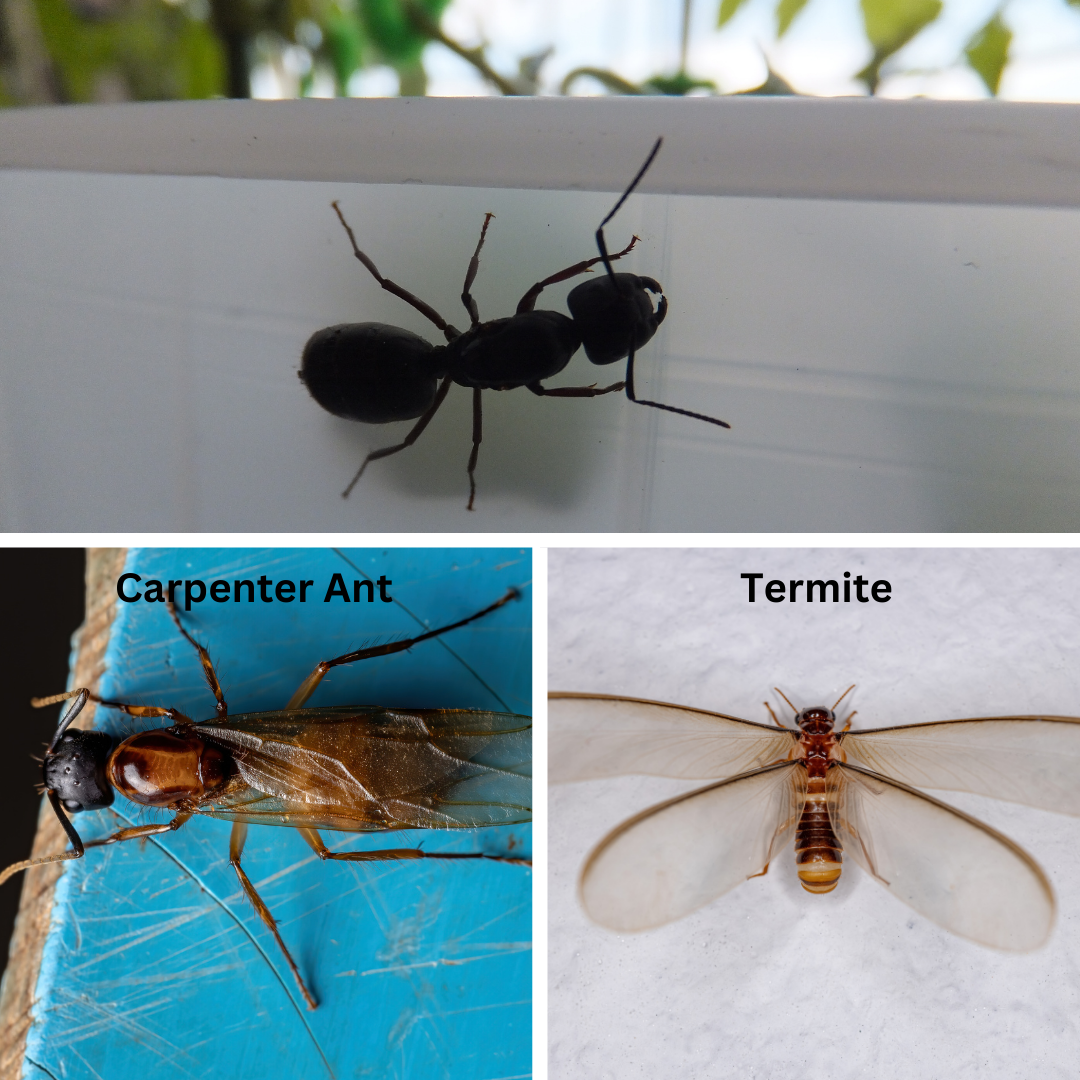
Appearance
Carpenter ants have a few distinctive characteristics that make them stand out. The first is their unique antenna. Carpenter ants have what is called an elbowed antennae. This means that their antenna break up halfway into a 90-degree angle. Another characteristic is that they are either all black or red and black. When they have wings, they get characterized as male or female ants. These are slightly larger and commonly get misidentified as termites. Termites have much shorter antenna and their bodies are the same thickness from top to bottom. Termites are also smaller measuring 3/8 inches.
Length on average:
Worker: 0.25-0.5 inches
Male: 0.5-0.75 inches
Female: 0.75-1.0 inches

Behavior
Carpenter ants get their name from being attracted to wood. They are often seen nesting in trees, tree stumps, decks, or inside homes. Most of the nests located outside are considered parent nests. Parent nests are where the ant colony houses the queen, worker ants, her larvae, and pupae. Once the parent nest becomes overgrown, some of the worker ants leave the nest to create satellite nests. These are the nests that are commonly found inside homes or wooden decks. Ants seek out rotted or soft wood because it is easier to chew tunnels and galleries through. Inside the tunnels, they store food, pupa, and larvae.

Signs of Carpenter Ants
Carpenter ants play an important role in the ecosystem. When they chew through rotted wood, they leave a sawdust material called frass. When found outside, this frass acts as a source of nutrients for the soil. The only reason that a carpenter ant nest would be inside of a tree is if the tree has already started to rot. They do not chew through the living parts of the tree, only parts that are already dead and decomposing. A carpenter ant colony will not kill a tree on its own. When frass is found inside of the home, look for piles of sawdust that are also mixed in with the ant’s diet. This includes pieces of insects, nuts, and seeds.
Pavement Ants

Appearance
A few of the easiest ways to identify a pavement ant are its antenna, spine, color, and size. First, their antenna are clubbed and have 12 segments. They also have a skinny spine with two bumps that connect their abdomen to their thorax. Their colors are either brown or brownish-black. Similar to carpenter ants, it is also common to see these ants with wings. The winged ants are the same size as the workers. They are usually seen in late spring and early summer. They can be seen in the middle of winter if there is a colony of ants inside a temperature-controlled area.
Length on average:
Worker: 0.3 cm
Queen: 0.6 cm

Behavior
Pavement ants are one of the most common found inside homes in Minnesota. If there is a colony or nest inside of a home, they are capable of being active all year long and can be seen foraging for food in the middle of winter. Their diet consists of dog food, sweets, oil/grease, meats, seeds, and insects. They will build nests inside the home under cement slabs, heated floors, foundations, and kitchens. Outside, most of their nests are located under driveways, sidewalks, and patios. The foraging ants that are visible outside the nest only make up 10% of the entire colony. The rest of the ants, including the queen, stay underground.

Signs of Pavement Ants
Spotting pavement ant activity usually starts with spotting sand. Sand mounds are most commonly spotted on the outside, but can be seen inside homes, usually on cement slabs or around the foundation. These ants are also commonly seen moving in long, single-file lines called trails, which usually lead to a source of food and sometimes an entry point into the home.
Acrobat Ants

Appearance
Acrobat ants get their name from lifting their heart-shaped abdomens above their heads. They commonly do this when feeling threatened. These ants have elbowed antenna similar to carpenter ants, but their antenna are yellowish-orange instead of black. Their bodies are either yellow or brownish-black. They can also be found with wings during the mating season between July and September.
Length on average:
Worker: 0.3 cm

Behavior
Acrobat ants prefer to make nests inside water-damaged or rotted wood. They build nests inside dead tree limbs, stumps, firewood, and hollowed-out tree cavities. When these ants invade homes or buildings, they nest in wall voids, baseboards, or door and window frames that are water damaged. Most of the nesting areas they pick were previously occupied by other insects such as carpenter ants or termites. Acrobat ants do not cause structural damage. Instead, they use previously built tunnels and galleries to use as a nesting sight.

Signs of Acrobat Ants
These ants can be spotted crawling across utility lines, pipes, or tree branches that either touch the home or lead inside the home. Just like pavement ants, they crawl in single-file lines or ant trails. Acrobat ants will forage 100 feet away from the nest for food and other resources.
Pharaoh Ants

Appearance
These ants can be light yellow or red and have darker-colored thoraxes that look black or dark brown. Their antenna are clubbed much like the pavement ant. The antenna are also made up of 12 segments. Another unique characteristic of these ants are that they are extremely small. They are half the size of a pavement ant. This makes it difficult to spot any other specific characteristic without using a magnifying glass.
Length on average:
Worker: 0.16 cm

Behavior
Pharaoh ants do not have swarmers to make new colonies. Rather than making new colonies, these ants perform budding. Budding happens once a nest has reached its full capacity or is in danger. A group of worker ants and sometimes another queen will bring some of their larvae and pupae to a new nest location. These ants have a distinct diet compared to other ants in Minnesota. Their diet includes items ranging from toothpaste and soap to shoe polish, though these are not their sole sustenance. They primarily eat dead insects, fruit juices, corn syrup, and cooking grease.

Signs of Pharaoh Ants
Pharaoh ants are known for making nests in the most random places, especially when it comes to building nests inside buildings or homes. Look for them nesting in sheets, towels, and clothing that haven’t been touched for a long time. They also make nests inside garbage and underneath different household appliances. They are commonly spotted on their feeding trails which usually are along electrical wires and hot water pipes. This is how they navigate through walls and between floors once they are inside.
Field Ants

Appearance
Field ants can vary in color from all black, brown, red, and a mixture of all of these colors. Other characteristics include their uneven thoraxes and single-node waist. The node connects the abdomen to the thorax. These ants also have 2 different-sized worker ants. There are major and minor workers in each nest.
Length on average:
Worker: 0.3-0.6 cm

Behavior
Field ants are rarely found inside of buildings and homes. They make their nests outside underground. Their diet consists of primarily honeydew, but also insects and sometimes household sweets. They obtain honeydew from eating other insects such as mealybugs and aphids. They will climb trees in search of aphids to eat and bring back to their nest.

Signs of Field Ants
Field ants are seen as a nuisance because they build large ant mounds in people’s lawns. The mounds can measure over 10 inches across. Not all nests are visible. Some nests are under trees, rocks, logs, firewood, and patio blocks. Field ants do not build nests inside of homes or buildings, though they can occasionally be seen foraging inside.
Odorous House Ants

Appearance
These ants are smaller in comparison to other inside ants. They can vary in color from brown or dark brown. One interesting fact is the origin of their name. When crushed, these ants release a strong, pungent odor often likened to rotting coconut or blue cheese.
Length on average:
Worker: 0.25 cm

Behavior
Odorous house ants have a similar diet to the rest of the ants of Minnesota, though they prefer to forage for sweet foods. They are also known to feed on insects and other meats or cooking grease. When these ants make their way inside, they crawl in single-file lines. Due to their small size, they are capable of getting into tightly packed foods inside pantries and cabinets.

Signs of Odorous House Ants
When outside, odorous house ants nest under rocks, wooden boards, mulch, or really underneath random objects. They will mate and construct new colonies by swarming. The winged odorous ants begin the swarming process in May through July. When these ants colonize a home, they establish nests in, on, or near hidden moisture sources, such as wall voids, beneath floors, and under home appliances.
Thief Ants

Appearance
Thief ants are the smallest of all ants found in Minnesota and are commonly referred to as grease ants. They range from yellow to light brown in color, similar to pharaoh ants. Due to their tiny size, specific characteristics can be hard to identify. These features include 2 bumps or nodes on their spine, the 10-segmented club antennae, and the absence of thorax.
Length on average:
Worker: 0.13 cm

Behavior
Thief ants get their name from nesting close to other ant colonies and nests. They are often spotted invading other ant nests and taking eggs, larvae, and other food. Similar to other ants, thief ants perform a nuptial flight to reproduce. While smaller than queens and larger than workers, both male and female thief ants have wings. Swarms of these ants can be seen between July and September.

Signs or Thief Ants
Infestations can be hard to spot because of their small size. They have been noted to build nests inside basements, under baseboards, and in the foundation. Outside, their nests are all underground. The entrance above ground is usually a good distance away from the nest itself. They look for areas in open fields such as lawns, golf courses, and agricultural fields. Most foraging ants can be seen outside the nest when temperatures are at their warmest.

If you have questions, concerns or want to schedule an appointment
Call Us Today! 952-404-BOGO (2646)
BOGO provides ant services for the Twin Cities and beyond!
Anoka|Apple Valley| Bloomington|Burnsville|Champlin|Chanhassen|Coon Rapids|Cottage Grove|Deephaven| Delano|Eagan|Eden Prairie|Edina|Elk River|Excelsior|Golden Valley|Independence|Inver Grove Heights|Lakeville| Lino Lakes|Long Lake|Maple Grove|Maple Plain|Maplewood|Medina|Minneapolis| Minnetonka|Minnetrista|Mound|New Brighton|New Hope|North Oaks|Orono|Prior Lake|Plymouth|Ramsey|Rogers|Roseville|Shoreview| Shorewood|Stillwater|St. Louis Park|St. Paul|Victoria|Waconia|Wayzata|White Bear Lake|Woodbury|
